Table of Contents
- Why Industrial Environments Demand a Different Standard
- The Main Types of Industrial Epoxy Floor Coatings
- Industrial Epoxy System Comparison at a Glance
- How to Select the Right System: A Specification Framework
- Surface Preparation: The Step That Determines Everything
- RFS Industrial Flooring Systems: Which One for Your Project?
- Application Tips for Industrial Epoxy Projects
- Frequently Asked Questions
- Summary: Choosing the Best Industrial Epoxy Floor Coating
Walk into any well-maintained manufacturing plant, food processing facility, warehouse, or aircraft hangar and you are almost certainly standing on an industrial epoxy floor system. Epoxy has been the backbone of commercial and industrial flooring for decades and for good reason. When it is correctly specified and professionally applied, a high-build epoxy system outperforms every other concrete coating on durability, chemical resistance, and long-term cost of ownership.
But ‘industrial epoxy’ covers a wide range of products from thin water-based coatings that barely qualify for the label to 100% solids mortar systems engineered to support aircraft. Choosing the wrong system for your project means premature failure, costly replacement, and a client who will not call you again.
This guide is written for professional flooring contractors and experienced DIY applicators. We will walk through the main industrial epoxy system types, how to select the right one for your project’s demands, the surface preparation principles that determine whether any system succeeds or fails, and how RFS’s own flooring systems fit into the industrial application landscape.
Who this guide is for
This is a technical supplier’s guide written for professional flooring contractors, facility managers, and experienced DIY applicators. If you are looking for a consumer garage kit recommendation, this is not that article. If you are specifying or applying a floor for a warehouse, manufacturing plant, food facility, hangar, or any demanding industrial environment read on.
Why Industrial Environments Demand a Different Standard
Standard residential and light commercial epoxy products the kind sold in big-box stores or specified for office lobbies are typically water-based systems at 40–55% solids content. They cure to 3–8 mils of dry film thickness. They look good, they are easy to apply, and they are appropriate for their intended use.
Industrial environments disqualify these products immediately. Here is why:
Film build
An industrial facility floor sees forklift traffic, dropped tools, dragged pallets, and chemical spills. Curing at 3–5 mils, a water-based system lacks the film thickness to absorb repetitive impact. Industrial systems are specified at 10–125 mils or more, sometimes multiple times that in mortar applications.
Chemical exposure
Oil, caustic cleaning agents, acids, hydraulic fluid, fuels, and solvents attack thin coatings progressively. Industrial epoxy systems use 100% solids formulations with specific chemical-resistant topcoats that standard products cannot match.
Load rating
Forklift axle loads can exceed 10,000 lbs concentrated on a small contact patch. Industrial floors are specified with compressive strength requirements that map to the actual load profile of the facility.
Seamlessness and hygiene
Food processing, pharmaceutical, and healthcare facilities require seamless floors with coved base details that prevent bacterial harbouring. Grout joints and surface porosity are non-starters.
Service life expectations
A commercial client specifying an industrial floor expects 10–20 years of performance. That expectation requires the right product, correct film build, and thorough surface preparation ,not a shortcut that needs to be re-coated in three years.
The single biggest cause of industrial floor failure
It is not the product it is the surface preparation. Even the best 100% solids epoxy system will delaminate from a substrate that has not been properly profiled, cleaned, and primed. Shot blasting or diamond grinding to ICRI CSP 3–5, thorough moisture testing, and appropriate primer selection account for the majority of whether a floor succeeds or fails at the 5-year mark. We cover this in detail in the Surface Preparation section below.
The Main Types of Industrial Epoxy Floor Coatings
Industrial epoxy is not a single product; it is a family of systems, each engineered for a different performance profile. Understanding the differences is essential to correct specification.
1. 100% Solids Epoxy: The Industrial Workhorse
100% solids epoxy contains no water or solvent carrier when it cures, virtually all of the applied material remains as film. This means the dry film thickness equals the wet film thickness, and there is no shrinkage or VOC off-gassing during cure. This is the baseline specification for most true industrial flooring applications.
- Typical DFT: 8–25 mils in standard industrial applications, higher in build-up systems
- Compressive strength: 10,000–14,000 psi depending on formulation ,stronger than the concrete beneath it
- Chemical resistance: Excellent resistance to oils, fuels, most acids and alkalis at standard formulations
- Cure time: 24–72 hours to full traffic (temperature-dependent)
- Best for: Manufacturing, warehouses, distribution centers, automotive facilities, general industrial
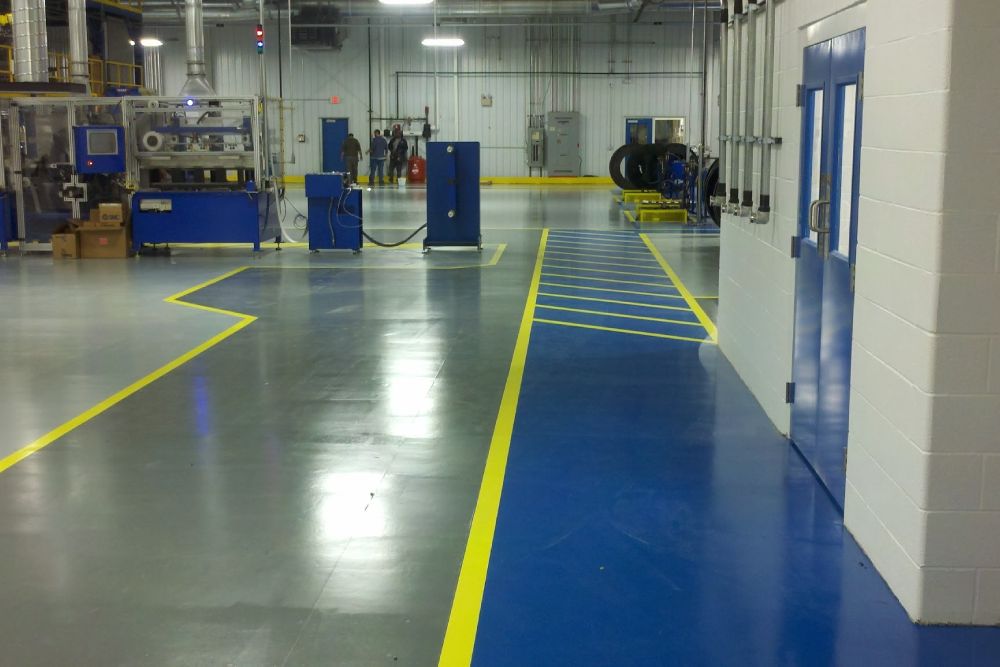
100% solids epoxy is the system type behind RFS’s Precise Chroma and Precise Flake systems. Precise Chroma delivers a seamless solid-colour finish ideal for clean zones, safety demarcation, and client-facing industrial spaces. Precise Flake incorporates a broadcast vinyl flake layer between base coat and topcoat, adding visual interest and additional surface texture for slip resistance.
2. High-Build Epoxy Mortar: Maximum Mechanical Resistance
Epoxy mortar systems combine 100% solids epoxy resin with graded silica aggregate or quartz sand, typically applied at 1/4″ to 1/2″ (6–12mm) thickness. The aggregate content dramatically increases compressive and impact resistance beyond what a standard epoxy film delivers.
- Typical thickness: 6–12mm (250–500 mils)
- Compressive strength: Up to 18,000+ psi
- Impact resistance: The highest of any epoxy system type withstands dropped equipment, severe forklift impact
- Surface repair: Also used as a cementitious repair mortar for spalled, pitted, or damaged concrete before a topcoat system is applied
- Best for: Loading dock approaches, heavy manufacturing, steel mills, facilities with aggressive mechanical impact
RFS’s Polymernation Systems occupy this space maximum film build, engineered for extreme mechanical stress and the most demanding heavy-industry applications in our product range.
3. Epoxy Quartz (Double-Broadcast): Chemical Resistance + Hygiene
Quartz aggregate broadcast systems use 100% solids epoxy as a binder, with graded quartz aggregate broadcast into the wet base coat and then sealed with a chemical-resistant topcoat. The result is a seamless, textured surface with outstanding chemical resistance, anti-slip performance, and hygienic properties.
- Typical system build: Primer + pigmented base coat + quartz broadcast + grout coat + topcoat
- Chemical resistance: Superior to standard 100% solids epoxy ,the quartz and topcoat combination resists acids, alkalis, and cleaning agents aggressively
- Hygienic properties: Fully seamless, coved base compatible, easy to sanitise ,meets USDA and FDA requirements when specified correctly
- Slip resistance: R11–R13 anti-slip ratings achievable with broadcast profile selection
- Best for: Commercial kitchens, food processing, pharmaceutical manufacturing, chemical plants, breweries, healthcare
This is the system architecture of RFS’s Precise Quartz, our most chemically resistant system and the primary recommendation for any application involving food contact, harsh cleaning chemicals, or regulatory compliance requirements.
4. Broadcast Flake (Vinyl Chip) Systems: Durability + Aesthetics
Broadcast flake systems use a 100% solids epoxy base coat with vinyl colour chips (flakes) broadcast to the surface, followed by a clear polyaspartic or urethane topcoat. The result is an industrial-grade system with high visual impact, good chemical resistance, and excellent wear characteristics.
- System build: Primer + pigmented base coat + full-broadcast vinyl flake + clear polyaspartic topcoat
- Abrasion resistance: The polyaspartic topcoat significantly outperforms epoxy alone on abrasion resistance and scratch resistance
- UV stability: Polyaspartic topcoats resist UV yellowing ,important for facilities with skylights or doors that open to sunlight
- Slip resistance: Inherent texture from the flake layer provides R10 anti-slip without additional aggregate broadcast
- Best for: Warehouses, distribution centers, automotive service bays, gym floors, commercial garages, showrooms
RFS Precise Flake is our most widely specified system across residential and commercial applications. For industrial environments with moderate to heavy forklift traffic, it is typically applied at higher base coat film build than the residential specification and paired with an industrial-grade polyaspartic topcoat.
5. Metallic Epoxy: Decorative Industrial Applications
Metallic epoxy systems use fine metallic pigments suspended in 100% solids epoxy to produce dramatic pearlescent, three-dimensional floor finishes. While primarily decorative, these systems retain full industrial-grade durability when a polyaspartic topcoat is applied.
- Primary use case: Executive spaces, showrooms, client-facing areas within industrial facilities
- Performance: Full industrial durability with polyaspartic topcoat, not a compromise on performance
- Design flexibility: Virtually unlimited colour and pattern combinations
- Best for: Automotive showrooms, corporate offices within industrial facilities, high-end commercial spaces
RFS Precise Radiance is our metallic epoxy system, 100% solids epoxy base with fine metallic pigments and a UV-stable polyaspartic topcoat. Appropriate wherever a client wants a visually striking floor without sacrificing durability.
6. Polyaspartic Topcoats: Speed + UV Stability
Polyaspartic coatings are a sub-category of polyurea, and while they are not epoxy, they are an essential component of most modern industrial flooring systems. They are almost universally used as the topcoat layer over epoxy base coats in professional specifications.
- Cure time: 2–6 hours to foot traffic is dramatically faster than epoxy topcoats
- UV stability: Does not yellow under UV exposure. Epoxy base coats will yellow if exposed to sunlight without a polyaspartic topcoat
- Flexibility: Slight flexibility compared to rigid epoxy reduces micro-cracking from thermal cycling and minor substrate movement
- Temperature range: Can be applied and cured in a wider temperature range than epoxy
- Abrasion resistance: Significantly harder-wearing than epoxy topcoats
All RFS Precise series systems use a polyaspartic topcoat as standard. For industrial projects, this is the correct specification, not an optional upgrade.
Industrial Epoxy System Comparison at a Glance
| System Type | DFT / Build | Best Application | Chemical Resistance | Cure to Traffic |
| 100% Solids Epoxy (Precise Chroma / Flake) | 10–25 mils | General industrial, warehouses, automotive | Good ,fuels, oils, most cleaners | 24–72 hrs |
| Epoxy Mortar (Polymernation) | 6–12mm (250–500 mil) | Heavy impact zones, dock approaches, steel mills | Good ,higher mechanical priority | 24–48 hrs |
| Quartz Broadcast (Precise Quartz) | Multi-layer system | Food, pharma, chemical, healthcare | Excellent ,acids, alkalis, cleaning agents | 24–36 hrs |
| Broadcast Flake (Precise Flake) | 10–20 mil base + topcoat | Warehouses, automotive, distribution, gyms | Good ,oils, fuels, light chemicals | 4–8 hrs (polyaspartic topcoat) |
| Metallic Epoxy (Precise Radiance) | 8–16 mils + topcoat | Showrooms, exec offices, client spaces | Good ,with polyaspartic topcoat | 4–8 hrs (polyaspartic topcoat) |
| Polyaspartic Topcoat only | 4–8 mils | Topcoat over existing sound epoxy | Very good ,UV stable, hard-wearing | 2–6 hrs |
How to Select the Right System: A Specification Framework
Every industrial epoxy project starts with the same four questions. Get these answers before you specify a product.
1. What is the traffic profile?
The single most important specification input is what will be moving across this floor and how often. Pedestrian-only traffic requires a very different system than a facility running 40 forklifts on three shifts. Key considerations:
- Forklift tire type: Solid rubber tires are significantly more abrasive than pneumatic tires and require higher DFT specifications
- Axle load: Maximum anticipated axle load drives minimum compressive strength requirement
- Traffic frequency: 24/7 operations require higher film build than a single-shift facility
- Point loads: Racking leg loads, press footprints, and static equipment positioning require specific substrate assessment
2. What chemicals will contact the floor?
Chemical exposure mapping is essential before product selection. The same epoxy system that performs excellently in a dry goods warehouse will fail rapidly in a battery charging station or food processing facility. Build a list of every substance that will contact the floor:
- Petroleum products (fuels, hydraulic fluid, cutting oils, lubricants)
- Acids (organic acids in food facilities, battery acid, cleaning acid descalers)
- Alkalis (caustic cleaning agents, bleach solutions, degreasers)
- Solvents (acetone, MEK, toluene ,require specific chemical-resistant topcoat selection)
Water and steam (wash-down facilities, food processing, laundries)
3. What are the hygiene and compliance requirements?
Regulatory-driven applications require documented system compliance:
- Food contact zones: USDA acceptance for incidental food contact. Precise Quartz is appropriate here
- Pharmaceutical manufacturing: FDA 21 CFR compliance, seamless, non-porous, cleanable surfaces
- Healthcare: Antimicrobial additive options available, confirm with specific regulatory requirement
OSHA: Documented slip-resistance ratings (minimum 0.5 COF, ANSI A326.3) for industrial walking surfaces
4. What are the operational constraints?
Cure time, installation temperature, and access restrictions determine which systems are practically achievable:
- Fast-return facilities (food processing, distribution): Polyaspartic topcoat systems return to traffic in 4–8 hours, a major operational advantage over epoxy-only specifications
- Cold environments: Standard epoxy requires substrate above 50°F (10°C) for correct cure, cold-cure formulations are available for refrigerated spaces
- Moisture: High moisture vapor emission from the slab (above 3 lbs/1,000 sq ft/24 hrs or 75% RH) requires a moisture-mitigating primer, skipping this step is the leading cause of epoxy delamination in new construction
Working hours: Phased installation to keep part of the facility operational requires careful scheduling and compatible section-to-section detailing
Surface Preparation: The Step That Determines Everything
You can specify the best industrial epoxy system on the market and still have it fail at year two if the substrate preparation is inadequate. Surface prep is not a cost to be cut, it is the foundation of the entire installation.
Mechanical Profile (Grinding or Shot Blasting)
Industrial epoxy requires a mechanical surface profile to achieve the adhesion strength the system is engineered to deliver. The ICRI (International Concrete Repair Institute) Concrete Surface Profile (CSP) scale runs from CSP 1 (light acid etch) to CSP 10 (heavy scarification). For most industrial epoxy applications:
- Standard 100% solids epoxy coatings: CSP 3–4 (medium shot blast or coarse diamond grind)
- High-build and mortar systems: CSP 5–6 (aggressive shot blast)
- Thin decorative overlays: CSP 2–3 (fine diamond grind)
RFS supplies surface prep chemicals, concrete grinding agents, and crack fillers to prepare substrates correctly before any coating is applied. Correct prep chemistry, including degreasing, acid etching where required, and concrete densification on polished surfaces, is as important as mechanical profile.
Moisture Testing
Moisture vapor transmission through concrete slabs is the most common cause of industrial epoxy delamination that is not immediately apparent at installation. Test using one of:
- ASTM F2170 (in-situ relative humidity probe): Results above 75–80% RH trigger moisture primer specification
- ASTM F1869 (calcium chloride test): Results above 3 lbs/1,000 sq ft/24 hrs trigger moisture primer specification
New concrete slabs require a minimum 28-day cure before any epoxy application. Slabs on grade in contact with soil without a vapor barrier are high-risk for moisture issues regardless of slab age.
Crack and Defect Repair
Active cracks (cracks that continue to move due to structural or thermal forces) must be addressed before any coating is applied. Dormant cracks can be routed and filled with polyurea or epoxy crack filler. Surface spalls, pits, and bug holes are filled with epoxy repair mortar, we supply the full range of repair products needed at this stage.
Priming
A penetrating epoxy primer serves two purposes: it fills micro-porosity in the concrete surface (eliminating outgassing bubbles in the base coat), and it creates a chemical bond between the substrate and the system. Skipping the primer step on porous or variable-porosity slabs is a shortcut that reliably causes problems. For moisture-affected slabs, a moisture-mitigating primer is specified instead of a standard penetrating primer.
RFS Industrial Flooring Systems: Which One for Your Project?
Resinous Flooring Supply carries a full range of industrial-grade flooring systems for professional applicators. Here is a practical decision guide for industrial projects:
Polymernation Systems
Maximum film build. Specify this for the most demanding mechanical environments: dock approaches under constant forklift cycling, heavy manufacturing press areas, facilities with aggressive rubber tire abrasion, or any application where impact resistance is the primary performance driver. This is our most heavy-duty system.
Precise Quartz
Maximum chemical resistance with seamless hygienic surface. Specify this for commercial kitchens, food and beverage processing, breweries, pharmaceutical facilities, battery charging stations, chemical storage, wash bays, and any zone requiring USDA/FDA compliance. The quartz broadcast topcoat combination outperforms standard 100% solids epoxy in chemical environments.
Precise Flake
High-build 100% solids epoxy with broadcast vinyl flake and polyaspartic topcoat. Specify this for general warehouse and distribution floors, automotive service bays, gyms, showrooms, and any industrial application where aesthetics matter alongside durability. The polyaspartic topcoat returns to traffic in 4–8 hours ,a major advantage on operational facility projects.
Precise Chroma
Solid-colour 100% solids epoxy with seamless finish. Specify this for safety demarcation, clean zones, parts storage, and any application requiring precise colour control for zoning, visual management, or brand standards. Also appropriate for aisle marking and pedestrian zone differentiation within larger industrial floor projects.
Precise Radiance
Metallic epoxy with UV-stable polyaspartic topcoat. Specify this for client-facing industrial spaces, executive facilities, automotive showrooms, and any application requiring a high-impact decorative finish within an industrial or commercial environment. Full industrial durability ,not a cosmetic compromise.
Edgemore Systems (Loft, Metro, Primo, Slate)
Decorative concrete overlay systems for non-industrial zones within industrial buildings, offices, reception areas, break rooms, mezzanine levels, and exterior dock aprons. Edgemore Slate is exterior-rated and appropriate for outdoor logistics areas, truck courts, and pool decks.
Application Tips for Industrial Epoxy Projects
Even experienced applicators encounter issues on industrial projects that residential work does not prepare them for. Here are the most important field considerations:
Temperature and Humidity Windows
Most 100% solids epoxy systems require substrate temperature between 50°F and 90°F (10–32°C) and relative humidity below 85% (non-condensing). Oklahoma’s climate means summer heat is a significant factor ,early morning starts on hot days are standard practice to stay within the application window. Polyaspartic topcoats have a wider temperature range and faster pot life management is required in summer conditions.
Pot Life Management
Mixed 100% solids epoxy has a working time (pot life) that varies with temperature. At 75°F, a standard industrial epoxy may have a working time of 30–45 minutes. At 90°F, that can drop to 15–20 minutes. On large industrial floors, poor pot life management results in ridging and application marks. Batch size, spread rate, and crew coordination must all be calibrated to the temperature on the day of application.
Outgassing
Concrete releases gas as temperature rises, particularly in the morning as a cold slab warms up in a building that has been heated overnight. If base coat is applied while the concrete is still outgassing, bubbles form in the curing film. The solution is to apply during the cooling cycle (afternoon or evening) or to use a penetrating epoxy primer that seals the slab surface before the base coat is applied. On industrial projects with large floor areas, this is a non-negotiable step.
Section Joints and Transitions
Industrial floors have control joints and construction joints that require specific detailing. Attempting to bridge an active joint with a rigid epoxy coating guarantees cracking over that joint. The correct approach depends on whether the joint is dormant or active: dormant joints are routed and filled with semi-rigid epoxy filler before coating; active joints are filled with flexible polyurea that will move with the concrete while maintaining a sealed, cleanable surface.
Frequently Asked Questions
What is the difference between industrial epoxy and regular epoxy floor paint?
Regular epoxy floor paint, including most products available at hardware stores, is typically a water-based, 40–55% solids product that cures at 3–5 mils dry film thickness. Industrial epoxy is a 100% solids, two-component system that cures at 10–25 mils or more, depending on the system. The difference in film build translates directly into durability, chemical resistance, and service life. For any genuine industrial application, 100% solids systems are the correct specification, not water-based paint marketed as epoxy.
How long does industrial epoxy floor coating last?
A professionally applied, correctly specified industrial epoxy system typically delivers 10–20 years of service life in manufacturing and warehouse environments. Longevity depends heavily on three factors: surface preparation quality (the most important), correct DFT for the traffic load, and ongoing maintenance. Facilities that clean floors regularly, address spills promptly, and repair minor mechanical damage before it propagates will consistently achieve the longer end of this range.
Can industrial epoxy be applied over existing epoxy?
Yes, in most cases ,provided the existing epoxy is sound (well-bonded, not delaminating, without significant mechanical damage), clean, and correctly profiled. The existing surface must be diamond-ground to create a fresh mechanical profile before the new system is applied. If the existing coating is failing or showing widespread adhesion loss, it must be removed mechanically before re-coating. We can advise applicators on bond testing protocols and topcoat-only vs. full system replacement decisions.
What causes industrial epoxy to peel or delaminate?
Delamination has four main causes: (1) inadequate surface preparation, the substrate was not profiled to the correct CSP or was contaminated at the time of application; (2) moisture, high moisture vapor transmission through the slab pushed the coating up from below; (3) application outside temperature or humidity parameters; (4) applying a new coat over a previous layer that had cured beyond its recoat window without mechanical preparation. The first two causes account for the large majority of industrial floor failures.
Where can contractors buy industrial epoxy flooring systems in Tulsa?
Resinous Flooring Supply carries the full range of professional industrial flooring systems, Polymernation, Precise Quartz, Precise Flake, Precise Chroma, Precise Radiance, and the Edgemore overlay series, from our Tulsa, OK location. We supply professional applicators and experienced DIY contractors. Call us at 918-528-4135 to discuss your project requirements and get the right system specified before you start.
Summary: Choosing the Best Industrial Epoxy Floor Coating
There is no single ‘best’ industrial epoxy floor coating; there is only the best system for your specific project’s demands. The specification framework is straightforward when you have the right information:
- Map the traffic: forklift type, tire type, load, and frequency
- Map the chemical exposure: every substance that will contact the floor, not just the obvious ones
- Identify compliance requirements: food, pharma, OSHA, or client specification
- Assess the substrate: concrete condition, moisture, existing coatings, active cracks
- Select the system: match the performance profile to the demands, use the comparison table in this guide
- Prepare correctly: surface profile, moisture testing, crack repair, priming, do not cut corners here
- Apply within parameters: temperature, humidity, pot life, and batch size management
At Resinous Flooring Supply, our job is to make sure professional applicators and facility managers have the right product in hand before the work starts,and the technical support to specify it correctly. If you are working on an industrial flooring project in Tulsa or anywhere in northeast Oklahoma, call us at 918-528-4135.